What Did the Kings of Israel Actually Look Like?
Over the next several months, Jeremy Stein, the director of the Center for Holy Lands Studies, will be sharing a series of articles that look at the Bible in light of archaeology. He will share insights into archaeological finds and how many not only confirm Scripture, but in some cases, provide additional insight into Scripture — as this article reveals.
What do we really know about the appearance of the kings of the Bible? The surprising answer is: very little.
The Bible gives us remarkably few physical descriptions of its kings. More often, Scripture describes them by their character, faithfulness, military strength, wisdom, wealth, or sin. Their appearance is rarely the focus. There are, however, a few notable exceptions.
Saul is probably the best-described king in terms of physical appearance. In 1 Samuel 9:2, we read that Saul was “a handsome young man.” The text continues, “There was not a man among the people of Israel more handsome than he. From his shoulders upward he was taller than any of the people.” Saul looked the part. He was outwardly impressive, strong-looking, regal, and exactly the kind of king Israel imagined it wanted.
David is also described physically, though notably this description comes years before he becomes king. Twice, the text notes that David was “ruddy,” with “beautiful eyes,” and “handsome” in appearance (1 Samuel 16:12; 17:42). Yet even here, the emphasis is not simply on David’s appearance, but on the contrast between what humans notice and what God sees. As the Lord reminds Samuel, “man looks on the outward appearance, but the LORD looks on the heart” (1 Samuel 16:7).
Beyond Saul and David, the descriptions become even thinner. Two of David’s sons, Absalom and Adonijah, are both described as handsome. Absalom, in particular, is said to have had no physical blemish from the sole of his foot to the crown of his head (2 Samuel 14:25,26), while Adonijah is also called “a very handsome man” (1 Kings 1:6). Yet Solomon, the son who actually ascended to David’s throne, receives no comparable physical description. Instead, the biblical writers focus on his wisdom, wealth, glory, and splendor (1 Kings 10; Matthew 6:29).
So, if the Bible gives us only a handful of physical descriptions, where else might we look? What if one of our best windows into the physical world of Israel’s kings comes not from the biblical text itself, but from archaeology?
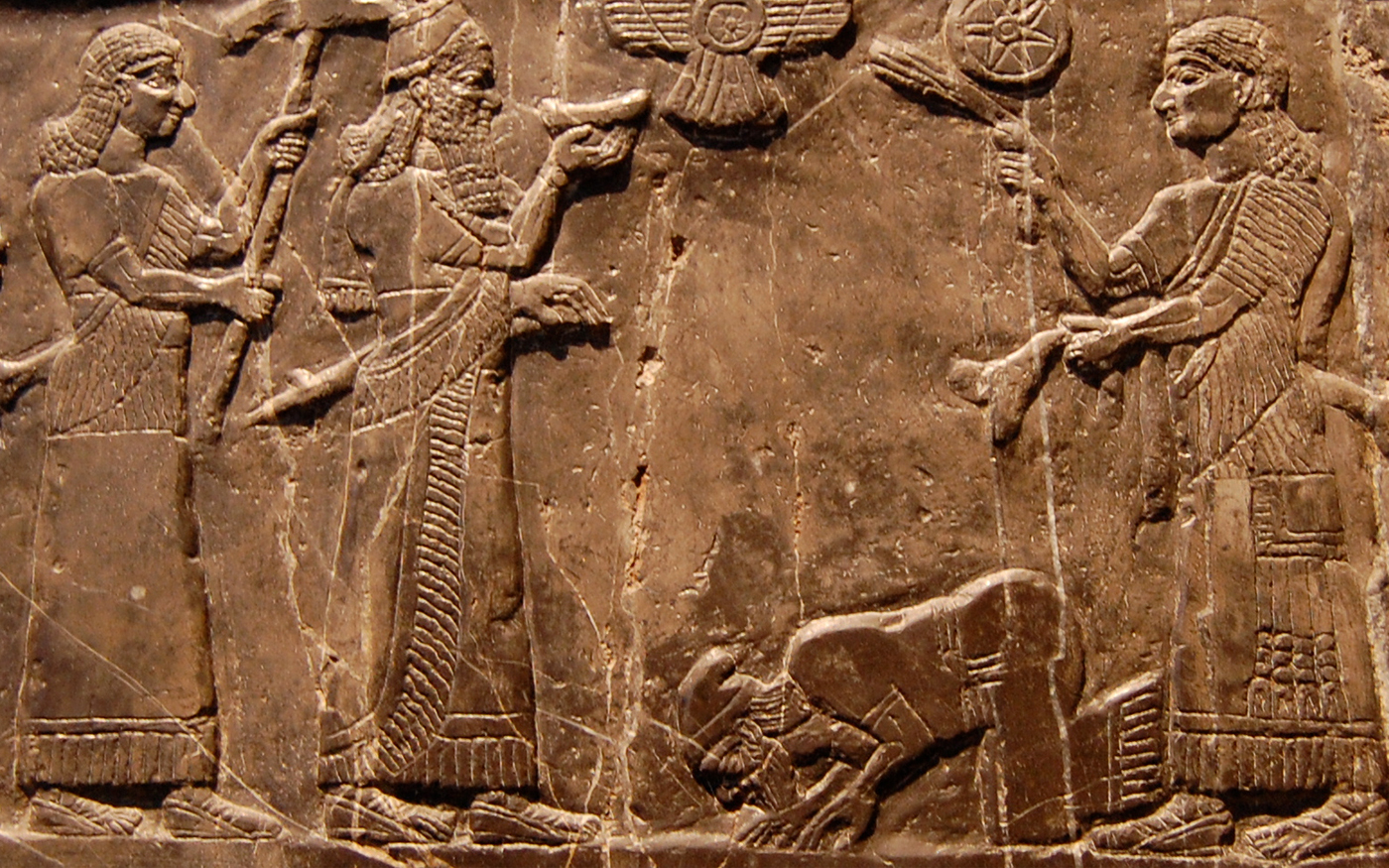
One of the most important ancient depictions of an Israelite king comes from outside the Bible: the Black Obelisk of Shalmaneser III. Carved around 841 B.C. and discovered in 1846, the Black Obelisk may provide one of the clearest visual clues for understanding how a king of Israel may have dressed, presented himself, and appeared before the great powers of the ancient Near East.
The obelisk contains 20 relief panels across its four sides. These panels depict five different foreign rulers bringing tribute to the Assyrian king Shalmaneser III. One of those rulers is identified in the inscription as “Jehu of the House of Omri.”
Jehu’s reign is recorded in 2 Kings 10. There we read of his violent overthrow of the house of Ahab and Jezebel, along with his execution of the servants of Baal. Yet the biblical account of Jehu closes on a negative note. He continues in the sins of his predecessors, and Israel begins to lose territory to Hazael of Damascus. What the biblical text does not mention, however, is Jehu’s submission to Assyria.
The Black Obelisk fills in that gap by describing a significant tribute brought to Shalmaneser:
“I received the tribute of Jehu of the house of Omri: silver, gold, a golden bowl, a golden vase with pointed bottom, golden tumblers, golden buckets, tin, a staff for a king, and spears.”
This inscription raises several historical questions. One of the most interesting is the phrase “Jehu of the House of Omri.” The Bible never presents Jehu as a descendant of Omri. In fact, Jehu is the one who brings Omri’s dynasty to a bloody end. So why would the Assyrians identify him this way?
Some have suggested that Jehu may have had some familial connection to the Omride line, perhaps through his father or through a lesser-known branch of the royal family. Others argue that “House of Omri” was simply the Assyrian way of referring to the kingdom of Israel. From Assyria’s perspective, Omri and his dynasty represented the height of Israel’s political and military power. The term may have continued to function as a designation for Israel long after Omri’s dynasty had fallen.
This interpretation is strengthened by the fact that the Mesha Stele, a contemporary Moabite inscription, also uses Omri as a way of referring to Israel’s power and dominance. For that reason, it seems likely that “House of Omri” functioned as a political label for the northern kingdom, rather than a precise genealogical claim about Jehu himself.
Still, the issue has led some scholars, even from the earliest publications of the inscription, to question whether the figure on the obelisk might actually be Jehoram, the son of Ahab, rather than Jehu son of Nimshi. For the purpose of this article, however, we will follow the traditional identification of the figure as Jehu.
If this is Jehu, then the Black Obelisk gives us the earliest known depiction of an identifiable Israelite king. It may also be the earliest known image of an identifiable Israelite at all. This makes the relief extraordinarily significant. It gives us a rare visual glimpse into the world of the monarchs we spend so much time reading about in the Old Testament.
And what we see may surprise us…
Jehu is shown bowing low before Shalmaneser, kissing the ground in an act of submission. He wears a simple garment. This is striking because the Assyrians around him appear in more elaborate dress, as we would expect in an imperial scene. Even more interesting, Jehu’s clothing appears humbler and simpler than that of the Israelite delegation accompanying him.
This raises an important question: Is this how a king of Israel normally dressed? Probably not. It is unlikely that the king of Israel dressed this simply in daily life or in his own royal court. Instead, the simplicity of his clothing may be part of the symbolism of the scene. Jehu is not being depicted as a powerful monarch in his own palace. He is being depicted as a subordinate ruler bringing tribute to a greater king. His posture, clothing, and presentation all communicate submission.
If this is the case, the image may help us imagine similar moments involving other kings of Israel and Judah who paid tribute to foreign powers. Kings such as Ahaz, Hezekiah, Menahem, and Hoshea all found themselves in positions of political dependence on larger empires. The Black Obelisk may offer a visual parallel to those biblical moments when Israelite and Judean kings stood not as independent rulers in splendor, but as vassals before imperial power.
Another striking detail is what Jehu does not appear to wear: a crown. In the relief, Jehu wears a simple head covering that does not clearly distinguish him from the members of his entourage. His attendants appear to wear similar coverings. By contrast, the Assyrian figures in the scene are visually marked by their own distinctive clothing and royal symbolism.
This is significant because we often imagine ancient kings with crowns, diadems, elaborate robes, and obvious royal markers. Yet the Old Testament rarely mentions Israelite kings wearing crowns. Saul’s crown is mentioned after his death. David wears the crown taken from the defeated Ammonite king. Solomon is associated with a crown in the poetic language of Song of Songs. Joash is crowned at his coronation. Zedekiah’s crown is removed in prophetic judgment. But when it comes to the kings of the northern kingdom of Israel, the Bible does not clearly describe them wearing royal crowns.
That does not mean they never wore them. But it does suggest we should be cautious about assuming that Israelite kings always looked the way later art and imagination have portrayed them. The Black Obelisk raises the possibility that at least in some settings, the king of Israel may not have been visually separated from his court as dramatically as we might expect.
Perhaps that is the most important contribution of this ancient relief. It challenges our imagination.
When we picture the kings of the Bible, we often imagine grand palaces, golden crowns, flowing robes, and men adorned with the finest luxuries of the ancient world. And at times, especially in the days of Solomon, that picture may not be far from reality. But the world of the northern kingdom may have looked different. Its kings may have appeared less extravagant, less visually elevated, and in certain political circumstances, far more “common” than our traditional images suggest.
The Black Obelisk does not answer every question about what Israel’s kings looked like. But it does give us something the biblical text rarely provides: a visual image. And in that image, the king of Israel is not seated on a throne in glory. He is bowed low before the king of Assyria.
That single scene reminds us that the kings of Israel were not only figures of biblical theology. They were also real men navigating a dangerous world of empires, diplomacy, tribute, and survival. Their appearance, like their politics, may have been shaped as much by vulnerability as by power.
Photo credit: British Museum, CC BY-SA 3.0 <https://creativecommons.org/licenses/by-sa/3.0>, via Wikimedia Commons